
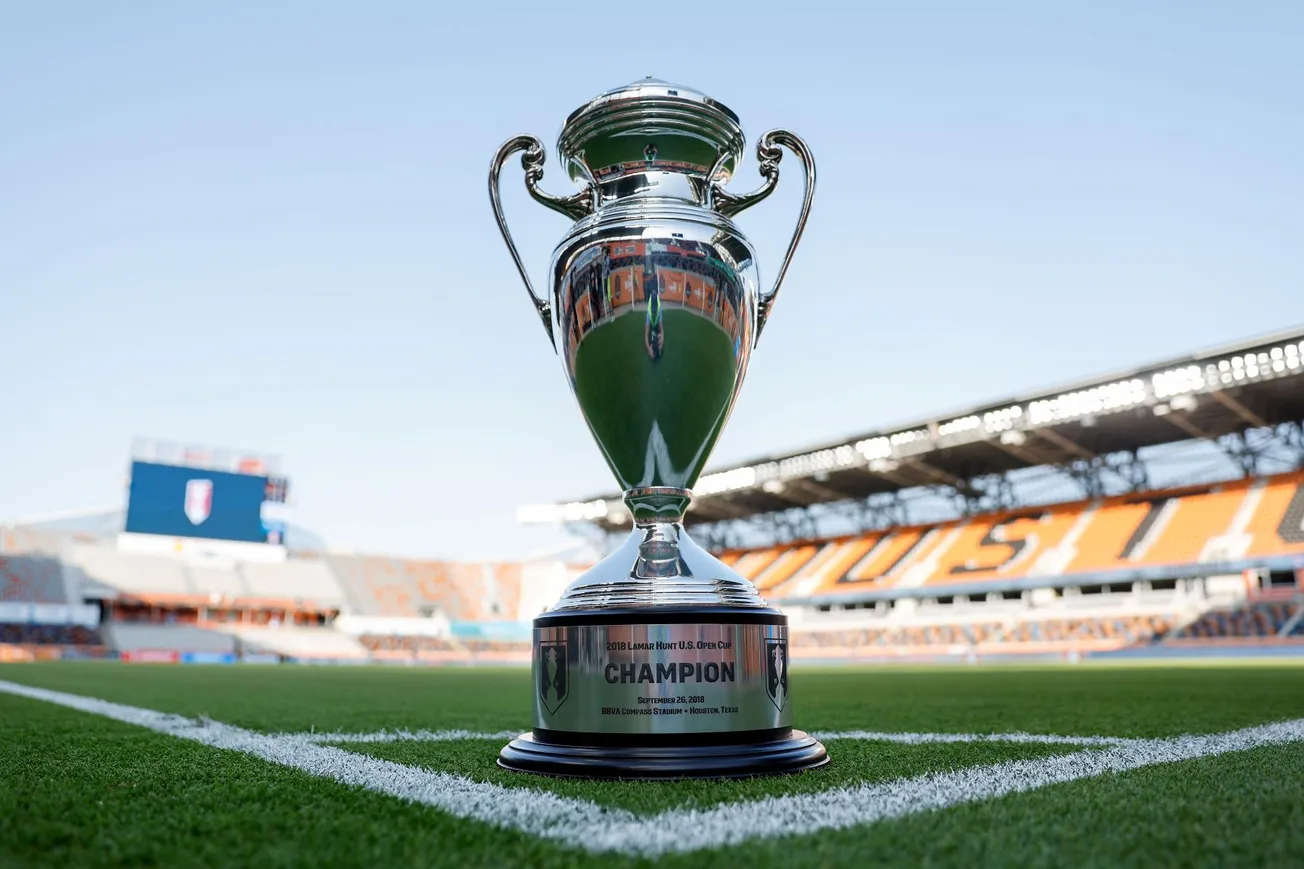
Officially known as the Lamar Hunt US Open Cup, the Open Cup is the only tournament in US soccer open to every men's club in the country. from "bullshit pub teams" (don't blame me, that's what Denver's Harpo's FC call themselves) to the aristocrats of MLS. It's really three tournaments wrapped into one, and it has been played since 1914.
Part one consists of qualifiers from the amateur ranks. You may see these clubs variously call themselves semi-pro, pre-professional, or amateur. Still, the bottom line is that players (and large chunks of staff) are unpaid and are officially lumped together as Open Division Qualifiers in the bylaws. This allows college students to suit up alongside people who have aged out of college but not found a professional home and grizzled former pros who can apply to "reinstate" their amateur status. In these facets, the qualifiers echo the completely separate USASA National Amateur Cup.
The winners of four rounds of qualifying, normally played between opponents who are geographically close to one another, have advanced from that stage into the tournament proper, where the rounds actually carry numbers. That is the first round of the tournament proper is always Round 1, regardless of the number of qualifying rounds before it.
16 clubs made it through the four rounds, which began last Fall.
They are joined by 16 clubs that received a bye into the first round based on their performance in the 2025 Spring season. It is in this group that you will find NPSL and USL League Two, the two leagues that have traditionally nominated based on the previous Spring's league results, and UPSL Spring Champion Tennessee Tempo. You also see the awarding of byes based on previous cup performance, in USASA Amateur Cup winners West Chester United and El Farolito, who were the most successful amateur side in the 2025 Open Cup.
US Soccer bylaws state that all "eligible professional sides" must compete. Still, they have found increasingly ingenious ways to define "eligible" so teams can play in other tournaments instead. The tournament winners qualify for the Concacaf Champions Cup the following season. Current "eligibility" means that those CCC clubs aren't eligible to play in the Open Cup, and therefore, the 2025 Champions, Nashville SC, will not defend its title.
Round 1 is the beginning of the second stage of the tournament. US Soccer has recently adopted seeding in Round 1 so that all qualifiers face a professional side, whether it is USL League One, MLS Next Pro, or USL Championship. 17 from the USL Championship, 13 from USL League One and two teams from MLS NEXT Pro will take part. This increases the likelihood of an upset, aka a #cupset, in slang. Because of travel considerations, the teams are usually drawn as close together as possible geographically, but there's always an outlier or two. That emphasis on minimizing travel across this vast country remains throughout the tournament, but Round 1 is the only time when all the ties feature an amateur club playing a professional one.
The third, and final, stage is when all the non-MLS teams have been eliminated. While this stage does not differ structurally from the second stage, it feels very different as the skill levels and drive flatten out the quality difference. The US Open Cup has been held since 1913-14. Still, the 30-year tenure of Major League Soccer as the country's first division is considered the Modern Era, with record-keeping for the preceding years sometimes lacking organization.
The last non-MLS team to win the tournament was a professional side - the Rochester Raging Rhinos (USL First Division - which was actually the second tier underneath MLS) in 1999. That club was dissolved in 2023, a fate that has befallen many former winners from the pre-Modern era. The last team to make the Final from outside the top division is Sacramento Republic FC, who are also a second-tier side - this time from the USL Championship in 2022.
So, that's the cautionary tale, but with this slimmed-down version of the Cup, two wins by a lower league side (whether that is amateur or non-MLS pro) lines you up a shot at one of those 16 MLS squads in the Third Round. Four more wins get you a spot in the one-off Open Cup Final, whose hosting is drawn at random (assuming both participants wish to host). The team from each division of the lower league Pros and the Open Division that advances the furthest in the tournament gets $50,000. The furthest-advancing amateur receives the 50k, the John Motta Trophy, and automatic entry into the following year's tournament. Six wins for a trophy (or four for MLS clubs) and entry into the Concacaf Champions Cup seems to be a low cost, even before factoring in a place in the pantheon of a 100-year-old tradition. Just getting to the final earns a club $250,000 and winning the whole thing will earn a club $600,000, so while money isn't the point of this festival of possibility, it's certainly a sweet bonus.
The upshot of all that is that 2 MLS NEXT Pro clubs, 13 Championship sides and 17 League One sides will open the tournament. They will face the 32 qualifying amateur sides. The Loons will be joined by 15 of the 27 USA-based MLS sides in the third round of the tournament. The full breakdown of which teams will play is available here, but note Forward Madison and Union Omaha of USL League One, and last year's darlings of amateur reinstatement, Des Moines Menace of League Two, all present in Round 1.
First Round Key Fixtures
Tuesday March 17th 8 pm ET - Indy Eleven (USL Championship) v Des Moines Menace (USL League Two) - Grand Park Events Center, Westfield, IN.
Wednesday March 18th 8 pm ET - BOHFS St. Louis (Midwest Premier League) v. Union Omaha (USL League One) - Lindenwood University, St Charles, MO.
Thursday March 19th 6:30 pm ET - Flint City Bucks (USL League Two) v Forward Madison FC (USL League One) - Don Batchelor Stadium, Grand Blanc, MI.