
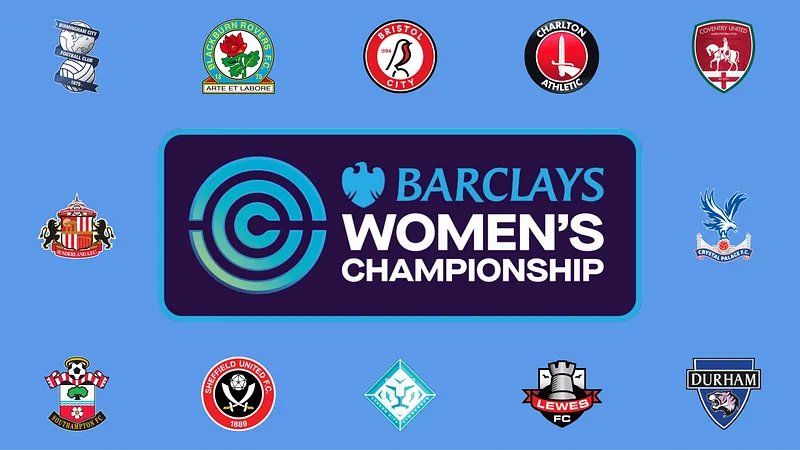
Beginning next month, we will be covering the Women’s Championship, the second — semi-professional — tier of the English league system
Unlike the concentration of London and Northwestern clubs in the WSL, the second tier has a wider distribution of locations. If you missed the clubs A-C, read it here
Durham play at Maiden Castle, on the campus of Durham University in the northeast of England, and is to that well regarded institution that we turn for the key pivot in the club’s history to becoming a WSL side. In a blueprint that could have been imported from the much more celebrated collegiate ranks of the USA, a local youth side (Cestria) took up partnership with, and tenancy at, Durham University. The county of Durham is 1000 sq miles and the decision not to call themselves Durham City, for instance, is one with history. Talking of history, they have no trophies to date.
Lewes FC play at former cricket ground, the Dripping Pan— home to the oddest ground name in the top two tiers — and it has existed since the earliest maps of the town were published in 1885. They also sport and support community ownership. In 2017, Lewes became the first professional or semi-professional football club to pay its women’s team the same as its men’s team as part of their Equality FC initiative. A year later, they were elected to the Championship.
London City Lionesses have a peculiar history. They have only existed since 2019, but they were formed as a spinoff of the much more storied Millwall Lionesses. The club with the London City moniker play 15 miles southeast of Millwall and about 20 miles away from the center of the metro, along the winding path of the Thames in Dartford. In their brief history, they are trophyless. And that brings me to Millwall Lionesses. From their founding in 1973 until the split, Millwall Lionesses won the FA Cup twice and cemented a place in the Championship (which would be handed to the newer club). The older club carved out an impressive niche as a fresh voice in a neighborhood whose men’s club was battling a reputation for hooliganism and racism. Fellow Millwall spin-off Charlton are a ready made rival in south London. Millwall are currently playing in the amateur London & South East Regional League.
Sheffield United have just moved home, to the club’s main stadium at Bramall Lane — which has hosted football since 1873. The unconnected women’s affiliate of the oldest football club in the world (Sheffield FC) had been playing Championship football between 2014 (when they were the first team ever to be promoted to that level) and 2018 (when they withdrew for financial reasons). United have not won anything in their existence.
Southampton play at St Mary’s Stadium, also the home to the men’s team. They are fresh to the Championship as winners of the National League Premier Division playoff (where North met South), and took the opportunity of promotion to turn fully professional. They were awarded “upward club movement” into the NL Premier despite the season having been cut short due to Covid — they were top of their division at the point of suspension. The UCM mechanism handles the rare exceptions to article 9 sporting merit, that is promotion and relegation. They are a relatively young club, having been founded in 2017, with the men’s club affiliation having moved from Southampton Saints Girls & Ladies — who subsequently collapsed. A passing nod also to Southampton Women’s FC, another separate club who have the second most FA Cups of any women’s team.
Sunderland play their games at Eppleton Colliery Welfare Ground in Sunderland, 10 miles south of the Stadium of Light and a loud echo of that site’s own colliery history. They have a ready made rivalry with Durham, which is 7 miles southwest of the site. The club that would become Sunderland AFC Ladies was founded in 1989, and funded alongside its men’s namesake between 2000 and 2004 before Sunderland AFC’s financial problems led to the side spinning off. In 2008, the independent Sunderland WFC were denied a WSL license. In 2013, the club was reabsorbed into SAFC. The following year they gained promotion to WSL2. In 2018, they were demoted after failing to secure a license for either WSL division but in 2021, they were also awarded “upward club movement” into the Championship because they finished top of their division but Covid meant no one completed the fixture list.
If your club spins out of control completely, there is a chance they could end up in the FA Women’s National League system — the amateur ranks. The cautionary tale here is Doncaster Rovers Belles (aka Donny Belles), who currently play in the 4th tier, WNL D1 despite having won the top tier twice and been runners up 7 times prior to the WSL. As detailed in our WSL preview, their license went to Manchester City instead. We will keep up with events in the lower leagues and spotlight interesting stories/clubs.