
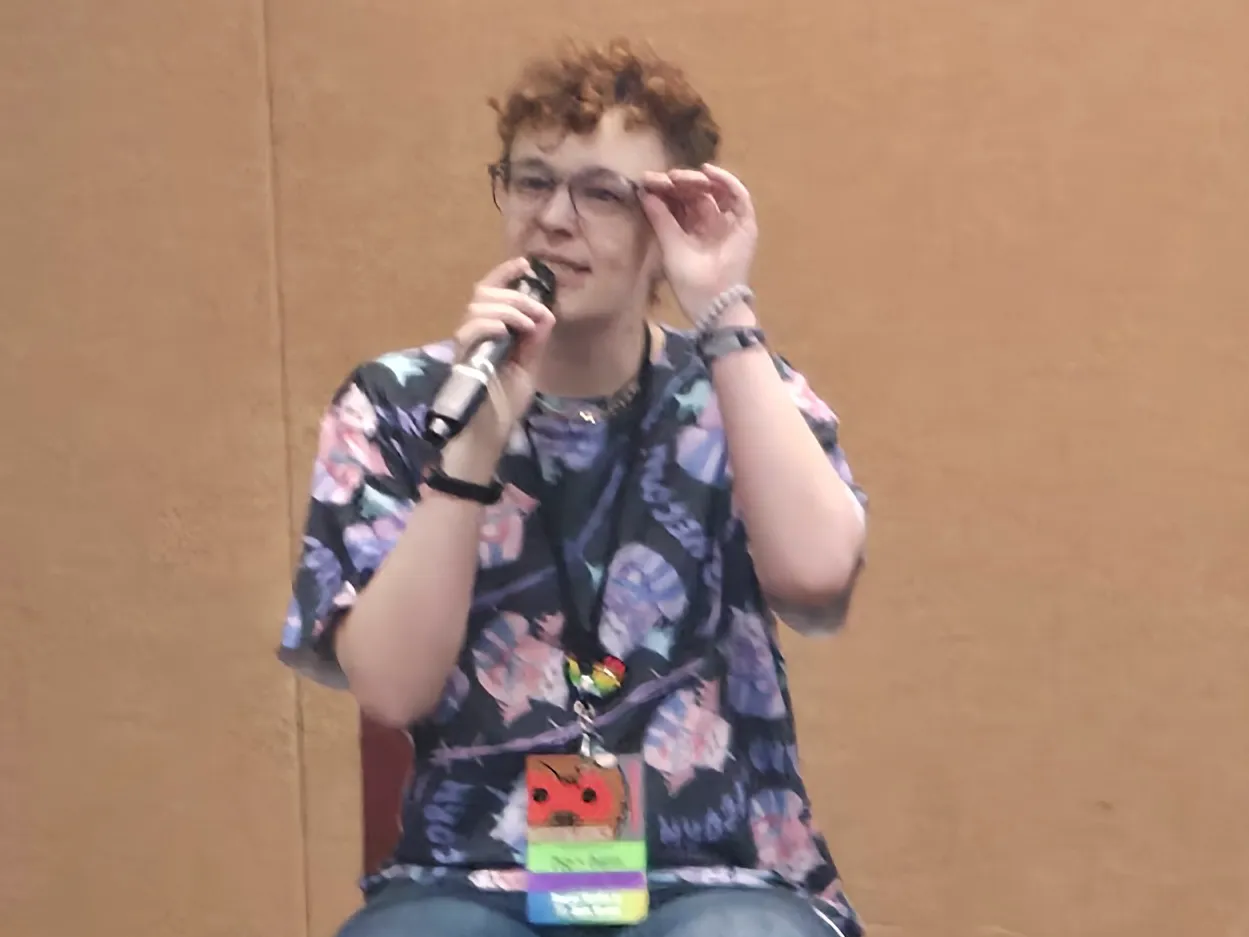
I'm aware that an anime convention in Fargo, ND, isn't soccer, but the booking of the Transgender and Non-Binary voice actor Ciarán Strange by the organizing committee of the boisterous three day event Anime Fargo offered a chance for a look into the life of a queer voice in that industry. Oh, and there was time for one footy question.
The tone was set by the Kamikazi Snowmen, a duo of AF veterans who offered this coda to Ciarán's introduction:
"Ciarán is far too dangerous, too evil, and too strange. They are too much chaos. They should be approached with extreme caution and wonderment, and also it should be expected to never sleep when they are within a one-mile radius of you."
I've known Ciarán for 13 years at this point, since an appearance on my Disability Rights radio show Technical Difficulties on Resonance 104.4 FM in London. It's been a pleasure to see him become a success, albeit in a different country (the USA) and a different job (voice acting) than were likely when they were a Vancouver based touring musician. Our focus at Northland Media is resolutely on the support of LGBTQ people and it is in that spirit that I embarked on a fly-on-the-wall mission at AF.
As I outlined above, it started well but Saturday was the key day, with two panels and an interview, the result is below.
If you are unable to listen, the conversation spans the technical nuances of dubbing, the evolution of gender identity in the industry, and the personal intersection of neurodivergence and professional performance. A full transcript is available, just email or DM me. Ciaran, a transgender bisexual non-binary man, discusses the complexities of "passing" in a hetero-leaning marriage and the professional shift from being a female-presenting musician to a male voice actor. He highlights the importance of positive masculinity, citing a "soft power" that rejects toxic patriarchal norms.
(On being two white men with the privilege that brings)
"You know, there’s that whole like you’re betraying by becoming a m- And it’s such crap. But it’s like I look to the men who are sources of what positive masculinity is. I know we’re all sort of trying to talk about that even within cis spaces. But, you know, you look at people like your Pedro Pascals, like your Macklemores, like, you know, your people that are out there. Tony Oliver is a hell of a dude. Like I dunno if you know of him. He’s the guy who brought Power Rangers to America. Speaking of positive masculinity, yeah. Just a very creative, powerful in his soft calmness. And I feel I’m being inspired a lot by those people right now. ’Cause I’ve always been a bit of a fire brand and a bit of a firecracker.
(Having known him for as long as I have, I can vouch for this!)
Ciarán Strange: So I’m trying to listen to those people and be inspired by those people who hold their space and their power so calmly and so confidently.
Tim Abbott: And soft is not a bad thing.
Ciarán Strange: No. Gentle. It can be a good thing. It can be a way to get your point across, and not be taken the wrong way. The Craft of Voice Acting
The discussion explores the technical rigor required for high-level dubbing: • "The Flaps": The challenge of matching English dialogue to Japanese mouth movements (mouth flaps).
"Some directors are real particular about the flaps ’cause I don’t know if you’ve, when you watch in Japanese, culturally, they don’t match the flaps as much as we do, so if you watch it in Japanese, it’s very interesting to see the, the flaps don’t always time out. Like, sometimes they’ll, the, they’ll still be talking and the character’s mouth is closed.
Tim Abbott: Wow.
Ciarán Strange: What I’ve learned from my colleagues, and my bosses, and my coworkers and everyone, and, and just fans, is that it’s just not as culturally important to them over there. Like, the flaps don’t have to match, but here where we animate to the words, so everything is so specific, people expect us to get it in the flaps. And a lot of it is our writers. We’re really lucky to have writers who will sit there and sort of go through it, and they all worked so hard, bless their hearts. One of my favorite writers, Jessica, and a couple others too, sometimes they’ll even come in on the first episode and kinda watch you do the characters. They can be like, “Okay, you’re a little longer. You’re a little shorter. This is how you’re stressing words. This is the kind of voice you’re using.” Because then if there’s, say, a big flap in the middle, they can try and make sure that there’s a word over it that would theoretically you can get that big flap out of.
Tim Abbott: Okay, yeah.
Ciarán Strange: There’s two kinds of flapping. You can try and get sort of everything and make it look as neat as possible, which- Dear Lord, when you get it in there. Oh, it’s so good. You watch it back and you’re like, “Whoa. You did it. Um, but then you have, um, I know that Jerry and others specifically will be like,”I want it to sort of match all around”, but if the internals aren’t quite the same, we’re gonna defer to the fact that this is a Japanese show, and so we’re totally fine. But sometimes you’ll spend forever on a line because the internals just look so messy, and there’s a big rogue flap in the middle, or there’s a bit in the middle where they closed their mouth for, like, a half a second and it just looks odd. And sometimes you can spend, like, 10 minutes on a line just working it and working it until it fits in those flaps. One of my favorite ones, I did one recently where I did the line and then you go straight into a big laugh, and then you come down, so you’ve got the mouth movements of the laugh, too. And then he goes right into the next line, and I timed it out so good and it felt so good. Me and the director gave each other the mental high five ’cause it feels good when you get it in there. • Vocal Range: Ciarán notes that being assigned female at birth (AFAB) allows him a unique range, enabling him to voice both masculine characters and "princesses" (as seen in The Apothecary Diaries).
Question: Since you are a transgender bisexual non-binary man, how does your consciousness of your gender and sexuality influence your work as a voice actor given that the original anime voices often had a different gender to the character they were voicing? That there were female voices voicing male characters quite comprehensively during the 1980s.
Ciarán Strange: I missed that. I feel, a shitty theory, that the industry grew up and they didn’t like that a bunch of women voiced all their male superheroes and so they’ve decided to change it. ’Cause it used to be very normal for AFABs to play protagonists. Um, and it doesn’t happen as much now. And a lot of the time, you’ll have guys voicing guys or girls voicing girls. But every now and then you’ll have a female who’ll come in playing a really solid dude character. And it’s fun. I find it very fun. Kurt from Atelier is like that, Richard from Requiem. And I find that: Number one, it immediately relaxes me because I can use a bit more of my range. I can have a bit more fun with my pitch. Whereas going into a role, say like Aoi from Ao Ashi, you know he’s voiced by a cis dude in Japanese and I get a little bit more stressed about it. Not necessarily in a bad way, it’s more just like I’m very aware that I have to sound more cis when I take those roles on. And I know that those are the ones where I get comments from people saying, you know, “Why does he sound like a girl" And definitely, its if I’m going into one of those roles where it was voiced by a cis dude and I’ve been given the opportunity by a director in English, I don’t read the comments. I hardcore recommend. I know a lot of new actors really like to read the comments, but you will find a comment you don’t like and it will break your soul. Trust me. Just know that people are talking about it and just vibe with it. Definitely when I come into a role where the guy was played by a female, I feel like, Mithril Rid Pod and Kurt, like I said, it definitely gives me more permission to use my full voice and my full range. Even if it’s just with reactions, like being able to do a high-pitched react. If it’s voiced by a female, even me as a dude, it gives me way more permission.
Tim: Do you approach the story from scratch? Do you take into account the original voice artist’s emotions, reactions?
Ciarán Strange: Yeah. We always try to match, even if we’re not matching the exact sound, because especially with reactions, you get a lot of reactions in Japanese that will sound very strange and very racist if you try to do them in English. So we always try to at least match the feel, the tone, the energy. There are some directors who definitely want to match the Japanese, like they want you to have almost the same pattern, the same connotation, the same level of vocal fry, the same emotion. Then there are directors that try to do their own little kind of spin on it for localization. And it’s funny because I don’t really have a preferred way of doing it or a way I think it, quote-unquote, “should be done.” I definitely love going in and having the challenge of having to match what the Japanese did, and I know that a lot of directors do love. Jerry Jewell’s a big one for that. He’s very much like, you know, they’ve done it. They want it to sound like this, so all we’re doing is bringing that into another language.
Tim : You’re open about your autism now in a way that you weren’t a decade ago when we last spoke about it. So talk to me about that journey and, and where you see yourself now, and what would you say to people listening to this who are either struggling with the diagnosis or with fitting into the neurotypical society?
Ciarán Strange: Totally. I’ll talk about autism. I also wanna talk about a second diagnosis since we last spoke and that definitely pushed me into wanting to be more open and honest. I was diagnosed with borderline personality disorder- which is a cluster B, and it is seen as one of the most aggressive, toxic disorders. We are very, very broken both by environment and genes. The suicidal tendency is huge. We have a hard time regulating emotions, finding an identity. There’s a lot of abandonment complex. But we are typically villainized; I forget what the incarceration rate is for people with borderline, but it’s absolutely astronomical. (Editorial note: studies consistently back this up) and the suicide rate’s 10%, so it’s not good.
One of the reasons I started being more open about both my autism and my BPD was that it is such a villainized stigma to be borderline that I wanted people to know that there was another side to it. There was a way out and a way forward. There was a life that could be had if you are on the correct medication, if you have access to medication. If you have a support group or a support structure, even if it’s just one person, you don’t have to fall into that life that is expected of somebody with BPD, somebody who is consistently churning through relationships, who can’t hold down a job, who is consistently flirting with breaking the law, who has trouble hanging on to reality. It’s called borderline because you are borderline psychotic. And it’s hard. There are times where my brain will make up things that haven’t happened, and I’ll have to sit down with the support group I trust, and they will kind of help me reconnect to reality. But the same with autism, I meet so many autistic folk at cons who are dealing with their own diagnoses or have just got a diagnosis, and it’s hard. It can be a relief almost. Like, when I was diagnosed as borderline, it was both heartbreaking and a relief because I felt like I finally had an answer for almost everything, including the things the autism wasn’t answering. I find that while it can be a very powerfully informative thing, but you can sort of see your life ending. You can be like, “Oh, gosh, what does this mean for me? Am I ever gonna be.” You know, “Does that mean that this isn’t just me being a teenager?” You know, “I’m not just going through a phase, and I’m not. This doesn’t go (away).” And it’s also important to just be visibly out there. I have a huge sensory disorder. I’ve started being a lot more open even just around friends with my eating difficulties. I’m a very picky eater, and I used to kinda hide it when we’d go to restaurants, and now I’m, you know, I’m like, “No, order that deconstructed burger.” I’m sort of allowing myself. And it’s hard. It’s really difficult to allow yourself to be that person sort of in public, and I know that a lot of people listening to this will probably be nodding their heads and going, “Oh, my gosh, yeah. No, I totally feel that.” But you also, when it’s safe for you to do so or when you feel like you are able to do so, you also don’t know who you’re inspiring or who’s seeing you take that brave step and go, “Wow, you know, maybe I can just make this a part of my normal life. I don’t have to fight against this. I don’t have to. You know, it’s okay if I have a tic. It’s okay if I have.” You know, I’ve got multiple friends who have tics, it just becomes part of their tapestry of who they are, and you just kind of don’t notice it after a while. But, you know, the amount of people I know who have physical tics who are like, “You know, I always, I feel it every time, and I’m always scared someone’s staring at me,” but you just don’t really notice. And I find, you know, that’s sort of something that, that sort of happens with me with eye contact. You know, I’ll be talking with people, and they’ll kind of look over their shoulder like, “What?” But most of the people who know me, they, they’re like, “No, Ciarán just rolls in and out of eye contact when. You know, that’s fine.”
Tim Abbott: Yeah, same, same
Ciarán Strange: Yeah, and I feel like it’s, nice to show other people that you can. It’s not like you’re hurting anyone. The parts of my, especially my borderline that, you know, the aggression, it’s aggression caused by fear and discomfort. That’s the part of my mental health struggle that I’m trying to deal with and get under control. But things like ordering my food a little different or, you know, um, maybe talking out of the side of my mouth sometimes or standing on the balls of my feet or picking at my hands or doing any of these other strange sort of things that I do that don’t necessarily hurt anybody, just sort of trying to be okay with those and show other people that, you can be a bit quirky. At least since like the 2000s and early 2010s, I feel like there’s definitely become a little bit more of an openness and an open-mindedness to, "we’re all a little different and we’re all a little quirky, and that’s okay, you know?"
Tim Abbott: Despite that high corralation between BPD and incarciration, the Substance Abuse and Mental Health Services Administration of the US federal government says that only 3-5% of violent acts are committed by a severely mentally ill person, and that they are 10 times more likely to be a victim of such a crime.
Ciarán Strange: With borderline you, you have a mentality that chases risk. So the amount of people with borderline who are likely to get into some kind of scuffle with the law or with gang activity or just end up in an unsafe situation because you don’t have any self-respect, you don’t have any self-love, and so you will put yourselves in these very extreme situations. So even for with a mental health disorder that is seen as being, a more abusive, aggressive disorder, there’s still a level of victimhood to it where your brain is forcing you into situations. You are a target, you know? And I have been a target multiple times for multiple people, and it’s scary. It’s scary to be open about having that disability or having something different about you because you know it could put a target on your back, right?
Now back to the pitch...
Tim: If you go into the stands, do you mask your queer autistic self? It’s a societal thing rather than that a person has ever said anything to me, but I honestly have never felt particularly comfortable being "out" at football matches.
Ciarán: I think it depends. Definitely men’s soccer, I would definitely be a bit more concerned. I’ve started watching a lot of women’s soccer recently. I watch a lot of NWSL, Angel City! I’m also a big San Diego Wave fan. I don’t know why I picked our rivals. I picked a derby! But one of the things I love about women’s soccer is, it's very queer. Like, there’s trans flags in the crowd.
Tim: Extremely queer.
Ciarán: So yeah, that kind of thing, hell yeah. Balls to the wall. I definitely feel like just because how I present is so masculine anyway these days, I think most people would just assume I was a lesbian and I would definitely use the women’s toilets.
It’s funny how that’s how I kind of judge everything, "which bathroom are you going into?" And most places in public, I do go into the women’s because it’s just safer. That’s how society sees me. They see me probably as a nice little lesbian, and I will just continue to ride that because that is what is safe for me. If I’m at cons, if I’m at a queer bar, if I’m somewhere where I feel a little bit safer, yeah, I’ll go out. I’ve been using the men’s loo at this con. Even though I’m in North Dakota, I still feel safe enough at this convention to go into the men’s toilets. It’s also, like "where would you wear a pronoun pin?" I definitely wouldn’t wear a pronoun pin to a soccer match. If you’re out there and you do that, hell yeah. More power to you. I’m definitely not saying that’s a bad idea. It’s definitely a thing I want to warm up to. I remember my wife saying a long time ago, like, “One day you’re gonna feel. You’re gonna know that even on a day you don’t pass, it’s just not gonna bother you. She’s like,”I have faith in this because you know you’re male, and we know you’re male, and the people who matter know. ” And I, I kinda scoffed it off ’cause I never believed that could happen, but that’s where I am now. It doesn’t matter because the people who matter know. And so if I’m standing with my friends and family at a soccer match, then I can enjoy that, and they know I’m a dude even if the people around me don’t. I’ve kind of gotten to a comfortable point, but I, do long for a time when...going back to specifically English football, England has always been relatively queer friendly, especially compared to the States. We had Dame Edna and we had Lily Savage, and, the idea of being queer was never handled the same way, even in sitcoms. So it’s just interesting how England has become a lot more anti-queer since the invention of the internet and certain authors paying money into Tufton Street to figure stuff out. But it just gives me hope that we can easily slip back the other way.
Tufton Street, JK Rowling and Trans Exclusion from Sports
Ciarán was very clear during her panel The Liminal Place at Anime Fargo that the reason people should stop putting money into Harry Potter is because JK Rowling is "literally funneling her money" into a place called Tufton Street in London.
If you’ve never heard of Tufton Street, it’s a huge think- there are multiple think tanks, conservative think tanks that exist in London and the LGB Alliance (which is based on Tufton Street) directly campaigns for Trans erasure.
"There is a direct correlation, not just between purchasing that stuff and hurting trans kids in the UK, where, by the way, now as a trans man, I am literally not allowed to pee in any public bathroom because I look too masculine to go in the women’s, and I cannot use the men’s ’cause it’s not on my certificate. So I physically cannot pee in public at the UK right now. So you’re not just hurting those people, it’s actually funneling back over here. And a lot of the talking points they get are from Tufton Street. There’s a huge pushback, and it’s just, it’s an easy way to control us. "they’re coming for your kids, they’re gonna queer your kids,". Closing off the worlds of queer kids isn't going to stop them, they’re gonna realize "who the hell they are, or they’re gonna know anyway, and they’re gonna have the confidence to pursue it."
Part 2 of this Special is here, bringing you a taste of the other elements of Anime Fargo. The inestimable Ciarán Strange can be found on Instagram and periodically on Twitch @strangebox.